Who am I? Click HERE to see my CV

Important!!! Use Firefox or Google Chrome to view this page. With Internet Explorer you may only visualize parts of this blog.

By Maria Zabala Peña at: englishforeso@yahoo.es or mariazabalapena@gmail.com. For ESL without photocopies go to my other blog HERE

New!! VIDEO BLOGS on English for Communications and on English for Office Applications (Computers). See links below.

English for Communications. Click HERE. By Beatriz Papaseit Fernández and myself, María Zabala Peña.
English for Office Applications (Computers). Click. HERE. By Beatriz Papaseit Fernández and myself, María Zabala Peña.
Showing posts with label Pronunciation. Show all posts

Improving pronuciation with Lyricstraining

Level: any. Students choose the level of their task
Procedure: Students:

  • Click the link below
  • Choose a genre
  • Pick a song
  • Choose your  level
  • Fill in the gaps in the lyrics. 
Click HERE to enter Lyricstraining


Pronunciation. How do you say...?

MORE WORDS ADDED TO THE LIST.
 IF YOU ARE A SPANISH NATIVE SPEAKER take a peek at the  list of words . New words have been added ! 

"How you say" is an on-line tool that will help you to learn how to pronounce words.
Aim: students introduce words they do not know how to pronounce in order to learn them with the sound Suggested procedure if you want to use this tool in your class
  •  make a list of the words students mispronounce.
  • group students in teams
  • write the words on the board
  • ask teams (in turns)  how a word is pronounced
  • check the pronunciation by introducing the  in How j say
  • give a point to the team that pronounces the word correctly
Access the HOWJSAY page by clicking HERE 

IF your students are Spanish speakers, you may start with some (or all) of these words:
  • Problems with "I" or "AI" sound:  to determine, idea, opposite, to  examine, horizon, since, microphone,  to print, tiger, virus, compliance  /kəmˈplaɪəns/  
  • Problems with stress pattern:  successful,  component (stress in "po"), foreigner, surface, insurance, hotel, interesting, incorregible (stree in KO), )
  • Words with two stress patterns: to present/ a present, 
  • The "able" words: vegetable, suitable (the "i" does not sound), able, comfortable, table, capable, removable, printable 
  • Letter B  does not sound: debt, plumber, doubt
  • Letter W does not sound:  sword,  answer, drawer. would, write, whiskey. awful, awesome 
  • Other silent letters: mayor (no "y"), heir (no h), guard (no u), shepherd (no second h), sign (no g) , know (no k), listen (no t)
  • The -es ending sounding as "iz"or "is". Most student ignore the ending: services, oranges, he fixes/watches, exercises, sizes
  •  The ones they always get wrong:  biscuit (the "u" does not sound), receipt, recipe, architecture (the K), busy, , key, Pharaoh, choir, aisle,rare, archive (K), corps  /kɔː/ as in Peace Corps vs. corpse.
  • The ones that are very similar to Spanish words and students pronounce in the Spanish: fashion: Jamaica, Arkansas, Zanzibar, Ottawa.Lancaster, Asia, South, Trafalgar  Square (stress on FAL)
  • The ones with less syllables than we expect: chocolate, digital, restaurant,  basically
  • Teasers (homophones or almost homophones): flour and flower,  guerrilla and gorilla, waist and  waste, pear and pair, heir and hair, write and right, four and for, hear and  here, no and know...  For more homophones in British English go to this page HERE
  • -age words: beverages (also stress pattern), village, image, message, usage

Pair work: how to read Internet domains and punctuation symbols

Emoticon symbol dictation

Aim: students work in pairs to dictate internate domains and emoticons. Students learn and practice how to say difficult simbols such as: dot  (.), dash (-), Ampersand (&), percent sign (%)...

You can donwload the materials for the teacher and students by clicking here 

Domain dictation


These materials  have been prepared by Beatriz Papasseit and myself , María Zabala Peña


Autonomous learning. What does your presentation sound like?

The Autonomous learning label contains tasks that students can carry out on their own.

 Use a text to speech page to ensure the correct pronunciation of your speech.

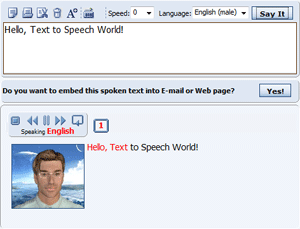
Imtranslator: write your text and listen to it!
  • Use any of the websites below
  • Copy and paste excerpts of your speech into the window you'll on the right
  • Choose speed, language (English) and avatar
  • Listen and take notes 
Link to imtranslator  (see picture) page:  HERE  
Link to acapellla page: HERE  

Link to natural readers page:  HERE


Thanks to our teacher trainer Mike O'Neill for providing us with the link to  the natural readers page. Course 77 at the British Council Summer 2012